
The Whisper That Started It All
It began as a quiet question that followed me in my first few years as a teacher. I had been working with young people from my community and now teaching them math in the local high school.
I can still see me walking through the halls one day, frustrated at the kind of disconnect I was experiencing. I was searching for ways to connect mathematics to students I cared about—students I knew were problem solvers, full of potential, and bright lights in the neighborhood. Why was it so easy out of school to engage yet so difficult while I was teaching math.
I can still see me walking through the halls one day, frustrated at the kind of disconnect I was experiencing. I was searching for ways to connect mathematics to students I cared about—students I knew were problem solvers, full of potential, and bright lights in the neighborhood. Why was it so easy out of school to engage yet so difficult while I was teaching math.
Why We Need to Design Differently
Over the years working with teachers, professors, schools and communities, the whisper has turned into this roar:
We know from decades of evidence and experience. They show that that students engage more deeply in STEM when lessons link to real-life contexts and authentic problems.
We also know that when classrooms focus on how students make meaning— when learning is rooted in curiosity, agency, and relationship — their confidence and performance grow. Culturally responsive approaches to mathematics confirm what many of us have seen firsthand:
We also know that when classrooms focus on how students make meaning— when learning is rooted in curiosity, agency, and relationship — their confidence and performance grow. Culturally responsive approaches to mathematics confirm what many of us have seen firsthand:
Hope as a Design Principle
Designing with hope is designing for connection. It shifts our focus in math and STEM from “What should students learn?” to "How should students be impacted" and “How can learning help them love, question, and build their world?”
My colleagues and I have spent hundreds of hours framing what this looks like in math tasks and lessons every day and what it requires. We knew that students were capable of powerful reasoning and creativity. What they needed were spaces where mathematics felt alive — connected to their experiences, their culture, their futures, and their communities.To design from hope is to:
- See mathematics as human work.
- Recognize that relationships, relevance, and rigor can coexist.
- Use standards as springboards for meaning, not ceilings for compliance.
The Hope Wheel as an Anchor
Full circle came in 2019 during as a result of requests to create math experiences in our teacher education courses that could respond to the many social moments we have seen in the last five years. Out of that search came the Hope Wheel—a framework of six action verbs: Love. Protest. Restore. Invest. Inspire. Create.
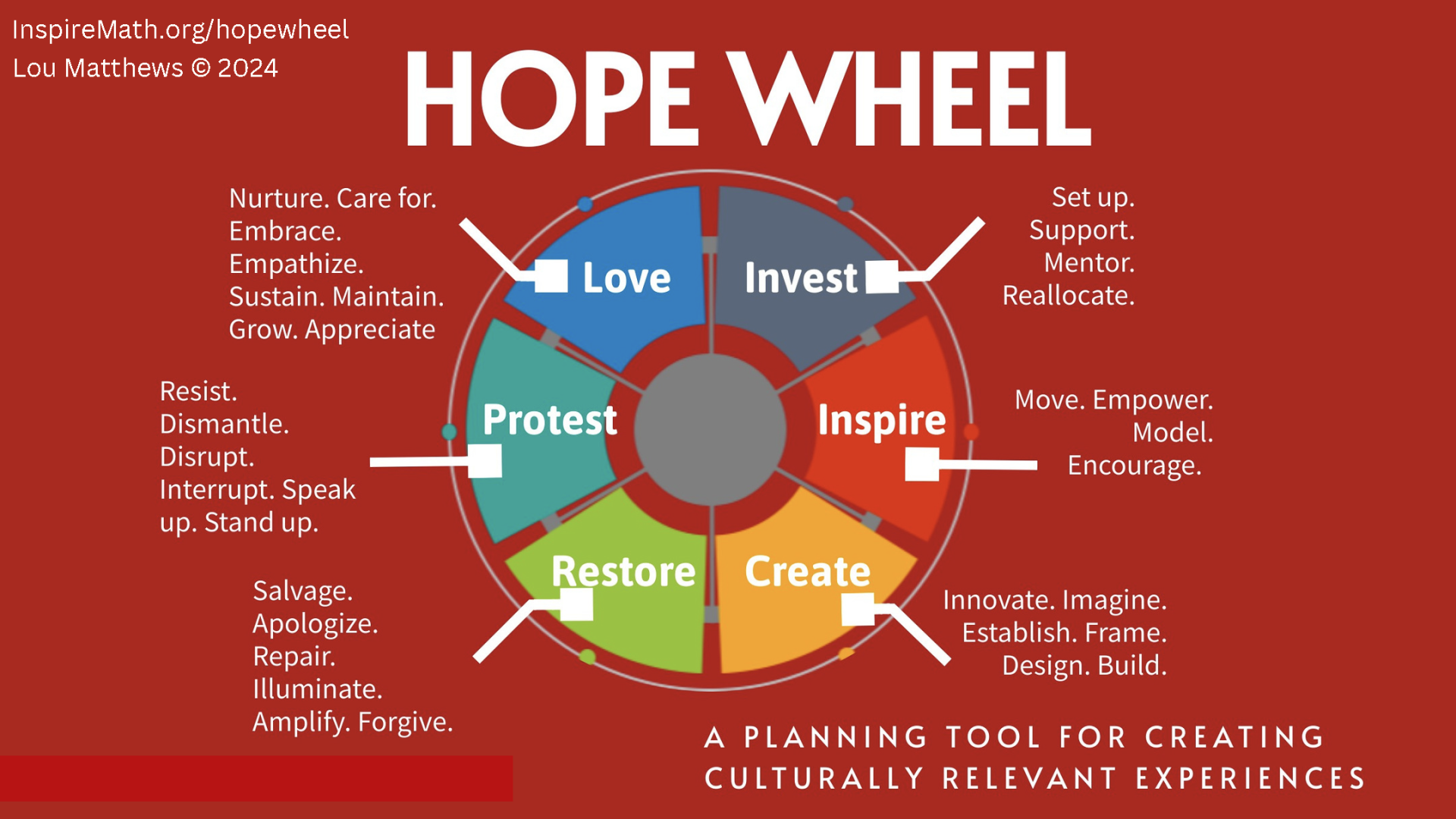
Each verb offers a way to design lessons that connect math to human purpose. It gives teachers language to move beyond Bloom’s Taxonomy—beyond remembering, understanding, and applying—into creating, connecting, and caring.
If Bloom helped us organize knowledge, the Hope Wheel helps us humanize it. It reminds us that mathematics doesn’t only describe the world; it can shape it. As a creation tool, the Hope Wheel has helped teachers move from traditional learning goals like:
If Bloom helped us organize knowledge, the Hope Wheel helps us humanize it. It reminds us that mathematics doesn’t only describe the world; it can shape it. As a creation tool, the Hope Wheel has helped teachers move from traditional learning goals like:
to human-centered goals like:
That simple shift—from procedural to purposeful—has helped our teachers see lesson design differently. In two series of professional learning centered around hope design, our teachers at the Inspire Institute have reported an average of 29% growth in confidence in planning math and science lessons but as one teacher stated "it's just different".
In our next issue in this series, we’ll take that idea further. We’ll explore Hope verbs and what math standards as living, human goals power design.
